Most of what gets written about AI citations is about ChatGPT and Perplexity. Claude searches the web too, and I wanted to know what Claude citations actually look like when it answers a buying question: which pages it opens, what format they are, and who wrote them. So I ran a small, deliberately boring experiment and wrote the method down before collecting anything.
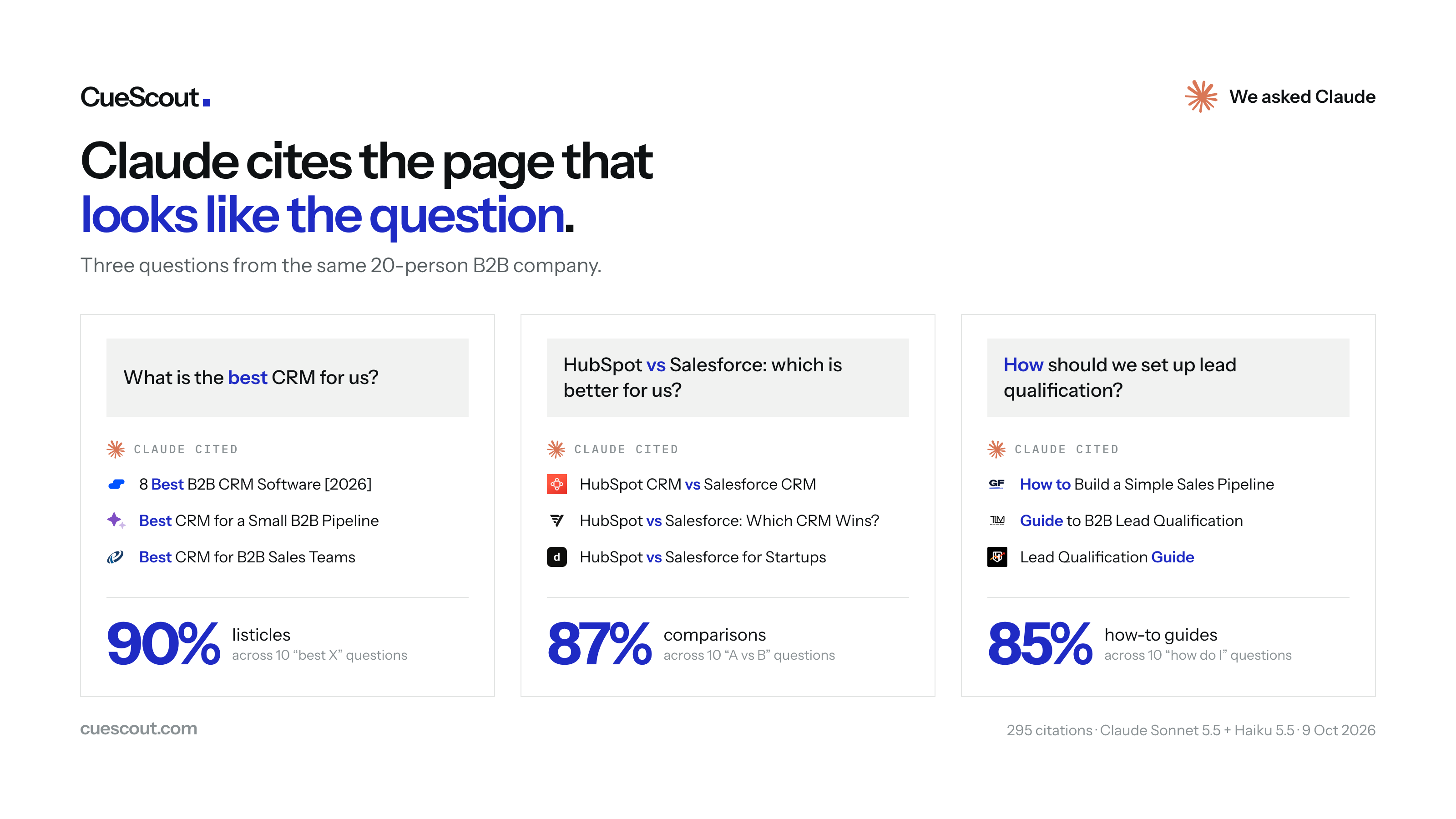
The short version is in the chart. The page Claude cites tends to have the same shape as the question it was asked.
Download the dataset (CSV, 295 rows): every citation from every answer, with the model, the question, the question type, the page title, the page format and who published it.
What I ran
Ten software categories (CRM, project management, email marketing, help desk, product analytics, internal wiki, social media management, SEO tools, e-signature, webinars) and three questions per category, all written for the same imaginary buyer, a B2B company with 20 employees:
- Best X: "What is the best CRM for a B2B company with 20 employees?"
- A vs B: "HubSpot vs Salesforce: which is better for a B2B company with 20 employees?"
- How to: "How should a B2B company with 20 employees set up a lead qualification pipeline?"
Each of the 30 questions went to Claude Sonnet 5.5 and Claude Haiku 5.5 separately on 9 October 2026, so 60 answers. Both used Anthropic's native web search, one search per answer, and a 180 to 250 word answer with citations. The system prompt told them not to prefer any source format. Every answer completed and every answer cited something. The whole run cost $1.84.
I counted only Claude's own citation objects. A URL written into the answer text without a citation behind it does not count, because a model writing a URL from memory looks exactly like a model citing a page it read, and I have been burned by that before.
Then every cited page got two labels: its format (listicle, comparison, how-to and so on) and its publisher (a software vendor, an independent site, or Unknown). Haiku did the first pass from page excerpts. A second review pass then checked 98 of the 212 pages we could fetch, which changed 5 format labels and 67 publisher labels. Most of those 67 had been marked Unknown even though the page named its own product. Both the model label and the reviewed label are in the CSV.
The result
| You ask | Citations | Listicle | Comparison | How-to | Other or unreadable |
|---|---|---|---|---|---|
| Best X | 86 | 77 | 0 | 0 | 9 |
| A vs B | 99 | 5 | 86 | 0 | 8 |
| How to | 110 | 1 | 0 | 94 | 15 |
The diagonal is the finding. Ask for the best CRM and Claude reads "8 Best B2B CRM Software" and "Best CRM for B2B Sales Teams in 2026". Ask HubSpot vs Salesforce and all 11 of its citations were head-to-head HubSpot vs Salesforce pages, from 8 different sites. Ask how to set up lead qualification and it reads guides with "how to" and "guide" in the title.
What surprised me more than the big numbers were the zeros. Not one best-X answer cited a comparison page or a how-to guide. Not one how-to answer cited a comparison. The only real leakage was 5 listicles turning up under A-vs-B questions, and one webinar question accounts for most of it: Zoom Webinars vs Livestorm got 4 comparison citations out of 9, the weakest of the ten.
If you pooled all 295 citations you would get roughly a third of each format and might conclude Claude likes how-to content. It does not, in this data. The prompt set was one third of each intent, and the pooled chart just mirrors that.
Who wrote the pages
Software vendors published 164 of the 295 citations, which is 56%. Independent publishers had 103 (35%) and 28 stayed Unknown. Every one of the 60 answers cited at least one vendor page.
The listicles are where this gets pointed. All 20 best-X answers cited at least one listicle written by a software vendor, and 56 of the 83 listicles in the whole set (67%) sat on a vendor's own site. Salesflare's "8 Best B2B CRM Software" and Kayako's "Best CRM for a Small B2B Sales Pipeline" are two of them. I did not check whether those vendors put themselves at the top of their own lists, so I am not claiming they did.
Comparison questions were the one place independent sites came out ahead, 49 citations to 44. "Independent" includes agencies and affiliate review sites, so please do not read it as neutral.
Sonnet and Haiku read different internets
For each question I compared the set of URLs the two models cited. The median overlap was 0.25 (Jaccard, so a quarter of the combined set), and 4 of the 30 questions had no URL in common at all. Sonnet cited more, 5.4 pages per answer against Haiku's 4.4.
The format mix was close, though. Both models followed the question's shape. They just found different pages of that shape, partly because each one writes its own search query. If you check one Claude model and call it "Claude visibility", you are looking at one model's reading list.
Where this is thin
It is one day, one answer per question per model, and 30 questions I wrote myself, all for software buyers. Nothing here supports a trend or a significance claim, and I would not read much into any single category.
It is also the API with one search and a short answer. The claude.ai app may search more than once and write longer answers, and that could change which pages it opens. 25 cited URLs could not be fetched and stay Unknown in every count above, and 114 of the readable pages still carry Haiku's unreviewed label. The CSV is published so you can check any of them.
How to get cited by Claude
Most "Claude SEO" advice I have read is generic: be authoritative, be clear, add structured data. This data points at something more specific. Write down the questions your buyers ask and sort them by shape before you write anything. A best-X question gets answered from listicles, so either get onto the lists Claude reads for your category or publish an honest one yourself. An A-vs-B question gets answered from comparison pages, so if buyers compare you with a named competitor and you have no page about exactly that pair, Claude is reading somebody else's. How-to questions go to guides that answer the how-to directly.
One page cannot cover all three. A product page did not show up much anywhere: 2 citations out of 295.
CueScout has a Claude add-on that asks Claude your tracked questions every day, next to ChatGPT, Perplexity and Google. If you only want to know whether Claude can read your site at all, the free AI crawler checker tells you whether ClaudeBot is blocked in your robots.txt.
Frequently asked questions
What kind of pages does Claude cite?
In our run it depended almost entirely on how the question was phrased. Asked for the best tool in a category, Claude cited listicles 90% of the time. Asked to compare two named products, it cited head-to-head comparison pages 87% of the time. Asked how to do something, it cited how-to guides 85% of the time. The rest were mostly pages we could not read and left as Unknown.
Does Claude prefer vendor blogs or independent sites?
Vendor pages made up 164 of 295 citations (56%), independent publishers 103 (35%), and 28 were Unknown. Comparison questions were the one place independent sites led, 49 to 44. Independent here includes agencies and affiliate review sites, so it does not mean neutral.
Is this what claude.ai shows people?
Not necessarily. We used the Claude API with Anthropic's native web search tool, capped at one search per answer and a short answer. The claude.ai app may search more, and its sources can differ. Read this as evidence about how Claude picks pages for a category question, not as a copy of what a given user sees.
Do Sonnet and Haiku cite the same pages?
Mostly not. For the same question, the median overlap between the two models' cited URLs was 0.25, and 4 of the 30 question pairs shared no URL at all. Sonnet cited 5.4 pages per answer and Haiku 4.4. Each model runs its own search, so part of the difference is the query it chose.
What is Claude SEO?
Usually one of two things. Some people mean using Claude to do SEO work. The other meaning, and the one this post is about, is getting your pages cited when Claude answers with web search. In our run the strongest lever was matching the page format to the question: listicles for best-X questions, head-to-head pages for A-vs-B questions, guides for how-to questions.
How do I get cited by Claude for a best-X question?
On this evidence, by being on the listicles Claude reads for that question, or by publishing one yourself. All 20 best-X answers cited at least one listicle written by a software vendor, and 56 of the 83 listicles cited were on vendor sites. We did not check whether those vendors ranked themselves first.