AEO tool
The AEO tool that tells you what to fix next
CueScout is an answer engine optimization (AEO) tool, for getting your brand into AI answers. It asks ChatGPT, Perplexity, and Google AI Overviews (plus Gemini and Google AI Mode on Growth) the questions your buyers ask, records whether each answer names or links your brand, and stores every page the answer was built from. The gaps turn into To-dos, and the next checks show whether the answers moved.
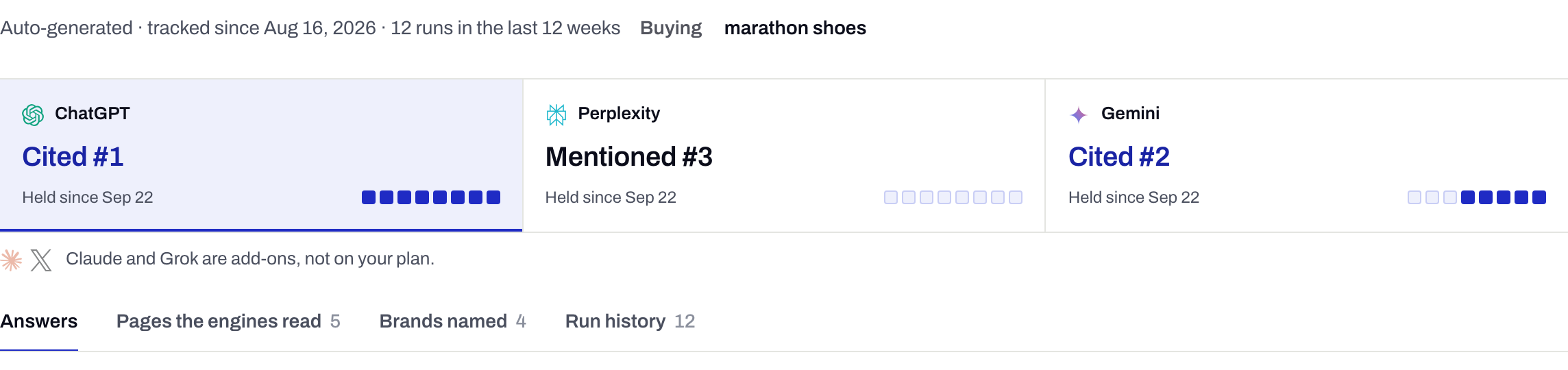
- 1One question, each engine’s verdict
- 2How long each verdict has held
- 5
- AI engines on Growth, 3 on Starter
- Daily
- tracking of every prompt; no answer is ever more than a week old
- 10 of 22
- Perplexity citations in our own category were Reddit threads (July 2026)
- 58 of 96
- AI-cited pages in one account had no top-100 search position (Brave Search index, August 2026)
Why answer engine optimization needs its own tool
The answer is written before the click
A buyer asks an assistant for a shortlist and gets three or four names. If you are not one of them, no ranking report will show you the loss.
Most of the answer is other people’s pages
Roundups, review sites and forum threads carry most AI recommendations. An on-page SEO audit never looks at them.
A score without a next step goes stale
Share-of-voice dashboards report how often AI answers name you compared with your competitors, as a percentage. The work lives in the cited pages and the questions nobody answers well.
What an AEO tool should show you, and what CueScout does
Per question
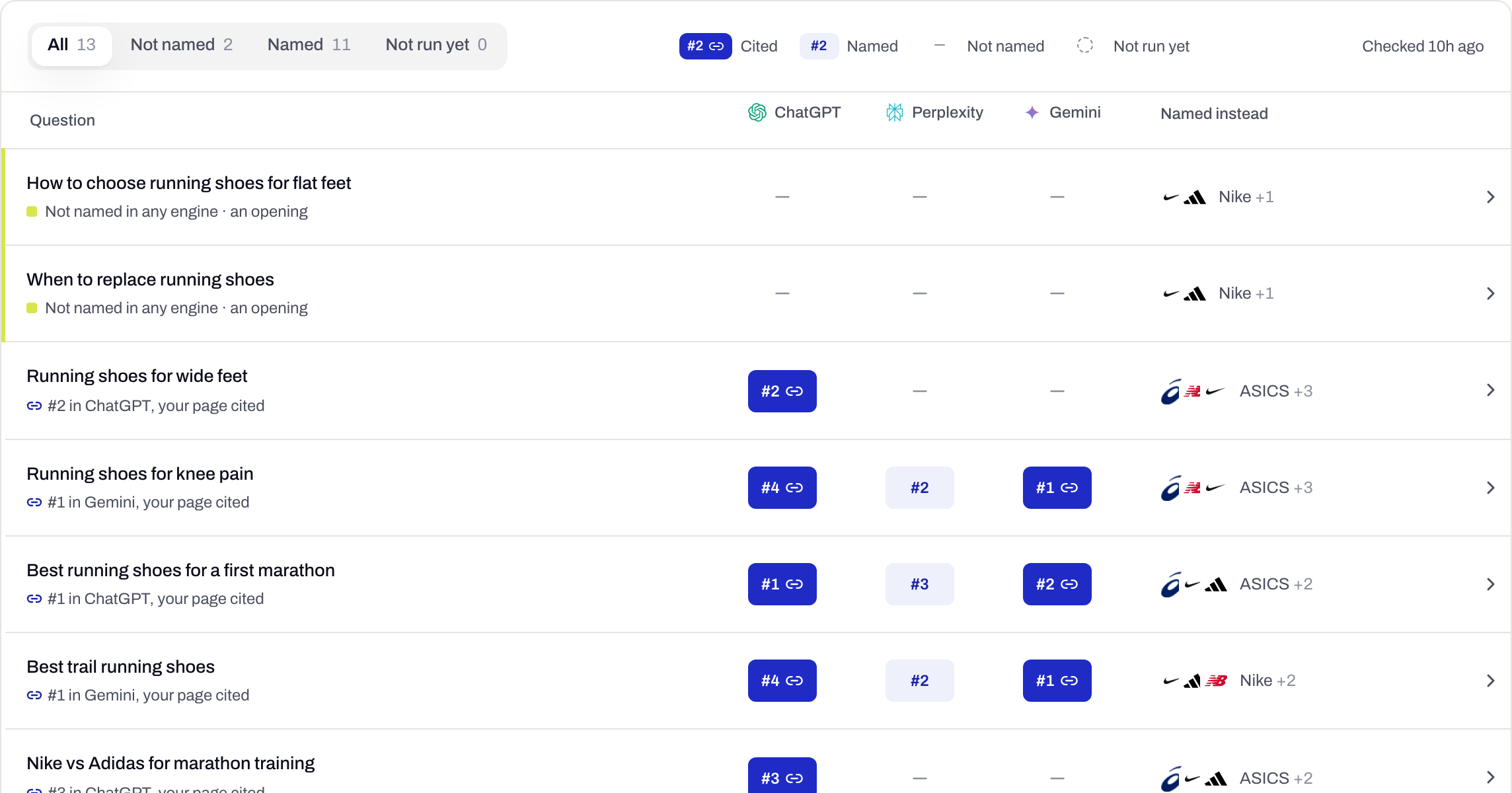
Each buying question, engine by engine
Each row shows whether the answer named you, linked you, or skipped you, and who it named instead. The questions no engine names you for float to the top as openings.
Engines
The AI engines that matter
Starter checks ChatGPT, Perplexity, and Google AI Overviews. Growth adds Gemini and Google AI Mode.
- ChatGPT
- Perplexity
- Google AI Overviews
- Gemini (Growth)
- Google AI Mode (Growth)
- Claude and Grok (add-ons)
Sources
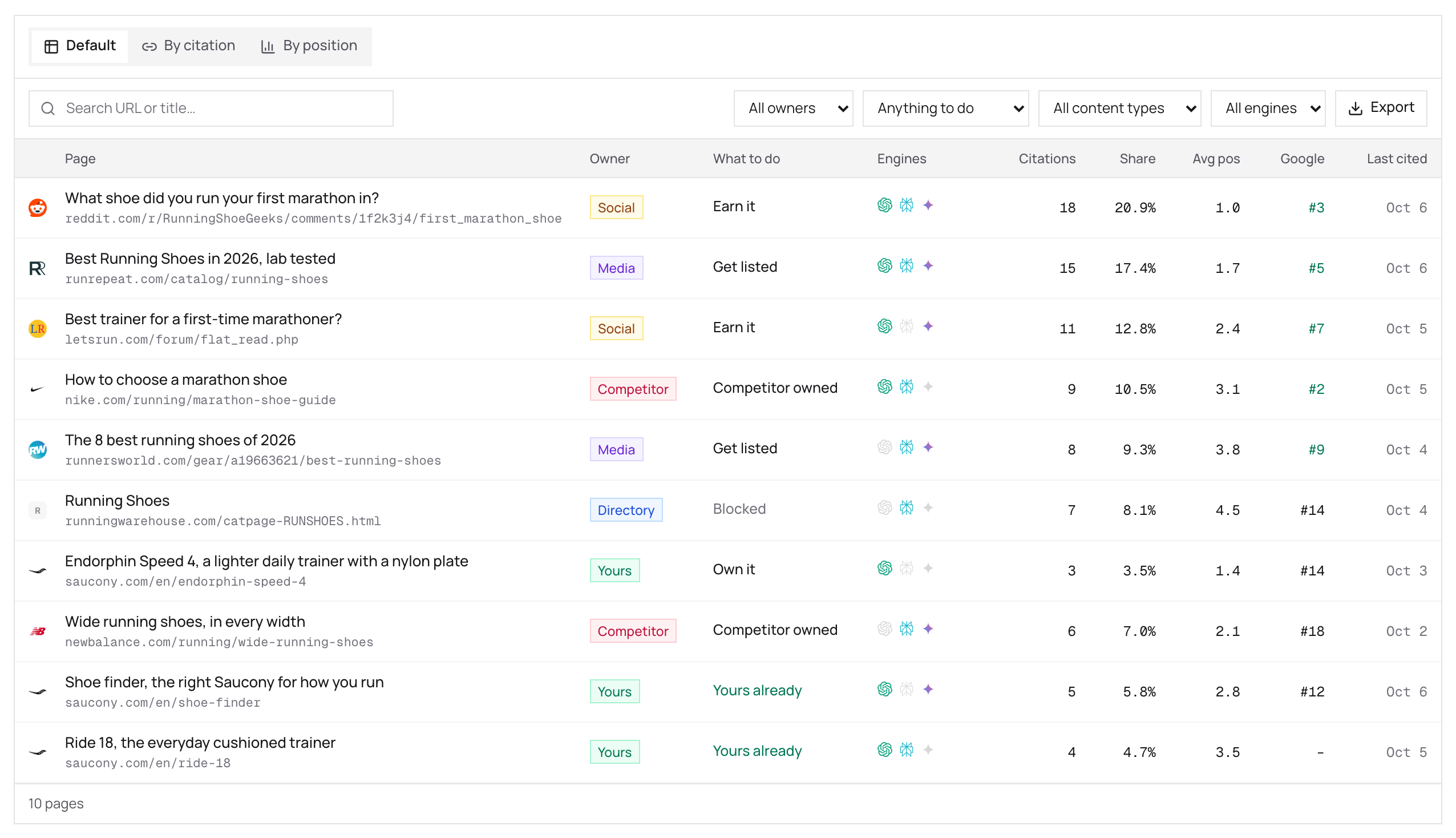
The pages behind the answer, sorted by what you can win
Every cited page gets a next step: own it, earn it, get listed, or leave it to the competitor who owns it. See AI citation tracking.
Work
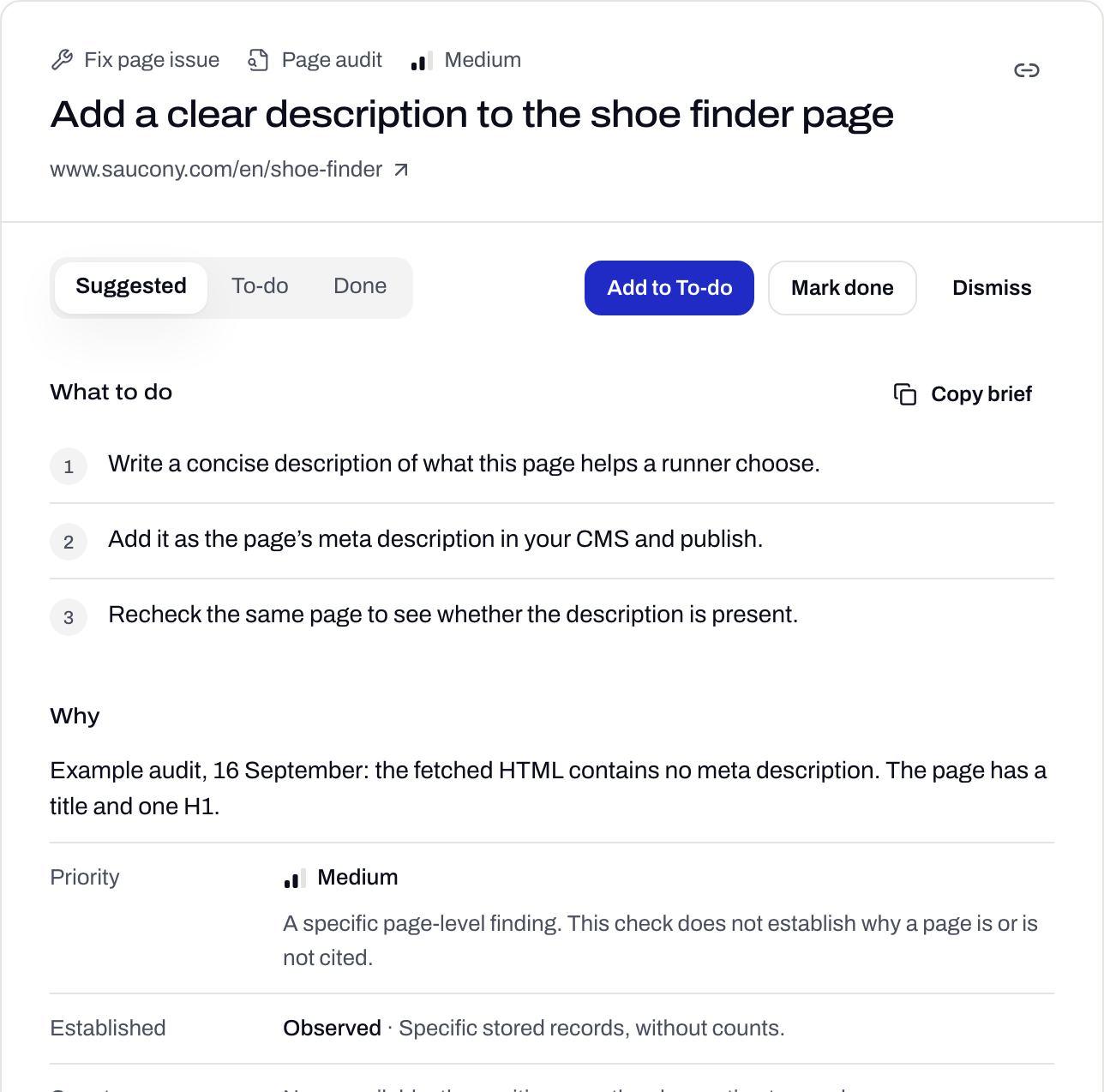
A To-do with the evidence attached
Steps, the reason, and the page it came from, ready to hand to a writer. When it ships, the same questions are checked again. See To-dos.
How it works
Starter tracks 20 prompts, Growth 100, every prompt tracked daily. Claude is a paid add-on, and the Grok pack asks Grok 20 questions you pick each week.
Compare plansPick the buying questions
CueScout suggests questions from your site and competitors. Keep the ones a buyer would type and add the ones you hear on sales calls.
Run a first check on each engine
Each question is asked on each engine your plan covers, then tracked daily. A zero is recorded as a zero, which is the honest place most brands start.
Trace the citations
The URLs behind each answer are stored, read and sorted by verdict, and the rank overlap check shows how many of them rank nowhere in search.
Fix, publish, check again
Work the To-dos in your own CMS. The daily runs show whether the engines start naming or citing you, and What changed lists every answer that moved.
An AEO tool against an SEO suite
| Aspect | SEO suite | AEO tool |
|---|---|---|
| Tracks | Your URLs in ten blue links | Your brand inside the AI answer |
| Competitors | Pages ranking near yours | Brands the answer recommends instead |
| Sources | Your own backlinks | Every page the answer was built from |
| Output | Rank changes | To-dos tied to the questions you lose |
What it doesn’t do
- It does not write or publish for you. You make the changes in your own CMS.
- Answers vary from run to run, so read the trend across daily runs, not one answer.
- A later citation after you publish is an observation, not proof that your page caused it.
- We do not report how many people ask a question. No public source measures assistant query volume.
Try it free
Run one free check, no signup: see whether ChatGPT names your product for a buyer question, and who it recommends instead.
Questions
What is an AEO tool?
An answer engine optimization tool checks what AI assistants like ChatGPT and Perplexity answer to your buyers’ questions, whether they mention or cite your brand, and what you could change to be included.
Is AEO different from GEO?
Mostly in name. Answer engine optimization and generative engine optimization both mean getting named and cited in AI answers. CueScout covers both, across the same engines.
Why do AI answers cite other sites instead of my homepage?
For buying questions they lean on comparisons, reviews and roundups written by someone other than the vendor. CueScout shows which ones, so you can see where you are missing.
Which engines does CueScout check?
ChatGPT, Perplexity, Gemini, Google AI Overviews, and Google AI Mode. Starter checks ChatGPT, Perplexity, and Google AI Overviews. Growth adds Gemini and Google AI Mode. Claude is a paid add-on, and the Grok pack asks Grok 20 questions you pick each week.
Do AI-cited pages rank in search too?
Often not. In one account in August 2026, 58 of 96 AI-cited pages had no position in the top 100 search results for the same question. Ranks come from Brave Search, an independent index, checked 100 results deep. That is one account, not a benchmark.
Related use cases
All use casesSee what the AI answers say about you
Your first check is free, with no signup to start.