AI citation tracking
AI citation tracking for the pages answers are built from
AI citation tracking means recording every page an AI answer cites. CueScout stores each URL that ChatGPT, Perplexity, Gemini and Google's AI list for your buying questions, checks whether your brand appears on it, and sorts the pages by what you can do about them: improve your own page, answer the question on your site, get onto a roundup, or leave it.
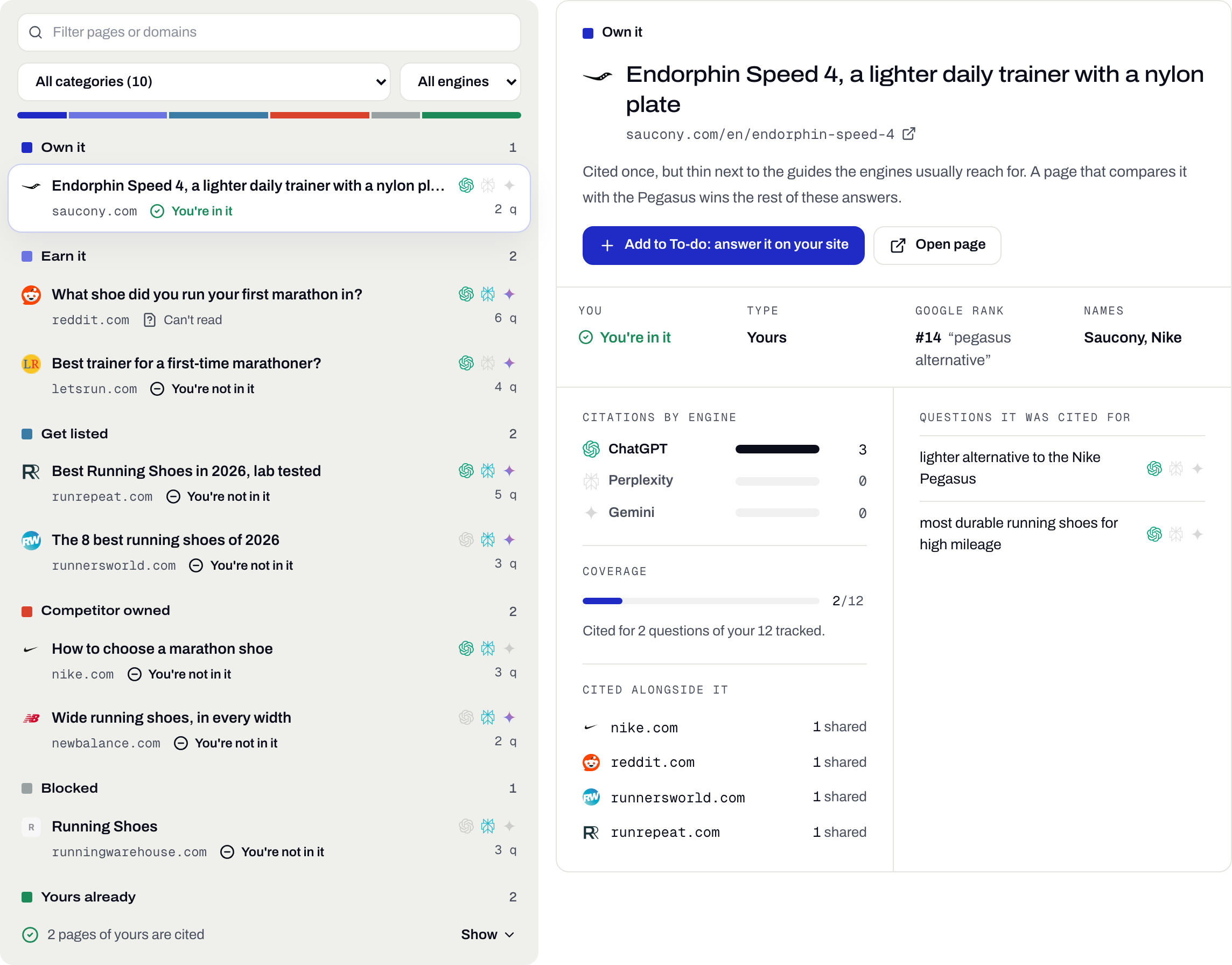
- 1Sorted by what you can win
- 2One click to a To-do
- 3Google rank for the same question
- 6
- verdicts, from "write this" to "you already hold it"
- 8
- page types, from Reddit threads to G2 listings
- 0
- extra AI calls: it reads the checks you already run
- 10 of 22
- Perplexity citations in our own category were Reddit threads (July 2026)
What citation tracking tells you about each page
Verdicts
Every cited page gets a next step
The list sorts by verdict, so the pages you can win sit at the top.
- Own it: your page, make it the best answer
- Earn it: answer the question on your site
- Get listed: pitch the roundup author
- Competitor owned: write the fair comparison
- Blocked: reviews move these, writing does not
- Held: you are in it already
Per engine
Which engine cited it, and for which questions
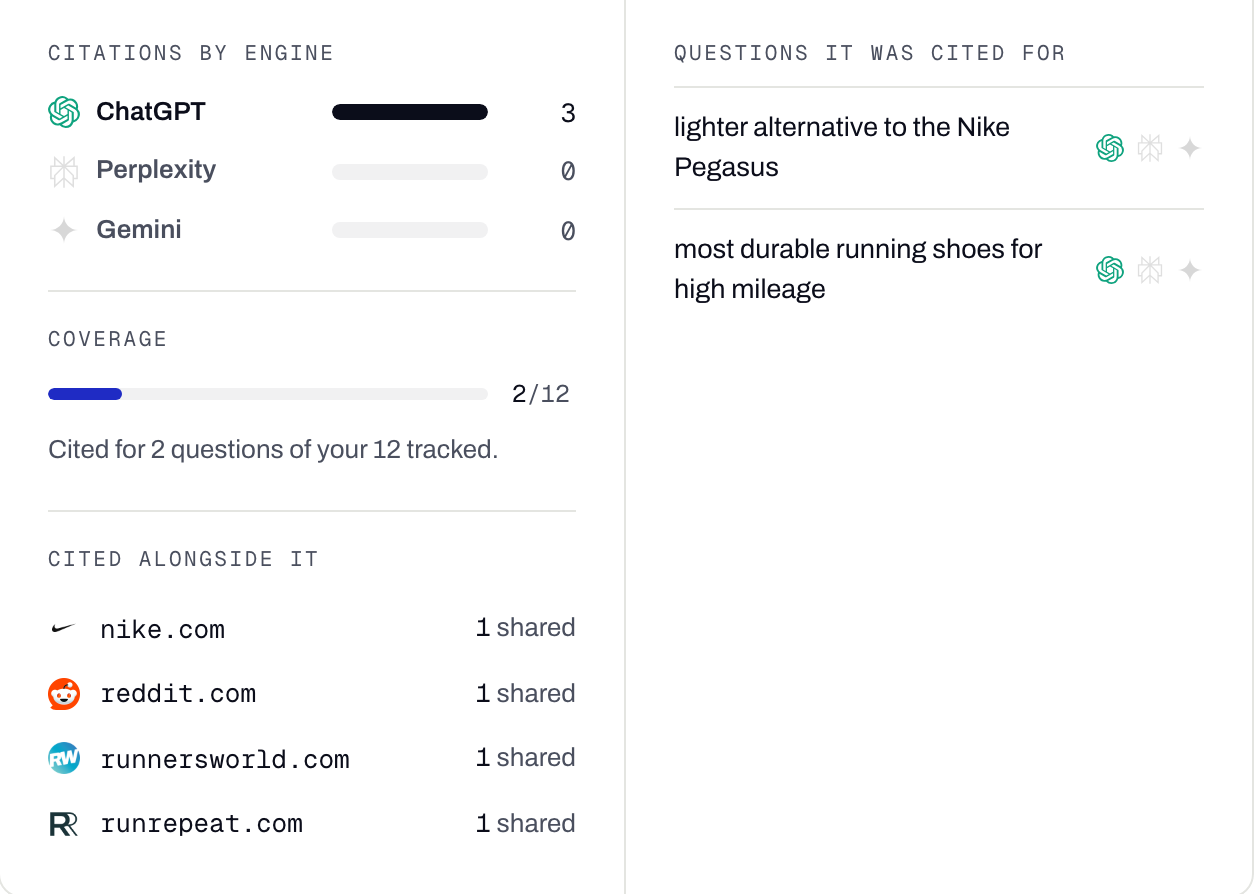
Every page carries the engines that cited it, the questions it was cited for, your coverage across tracked questions, and the domains cited alongside it. A handful of domains usually supply most of a category.
Straight to work
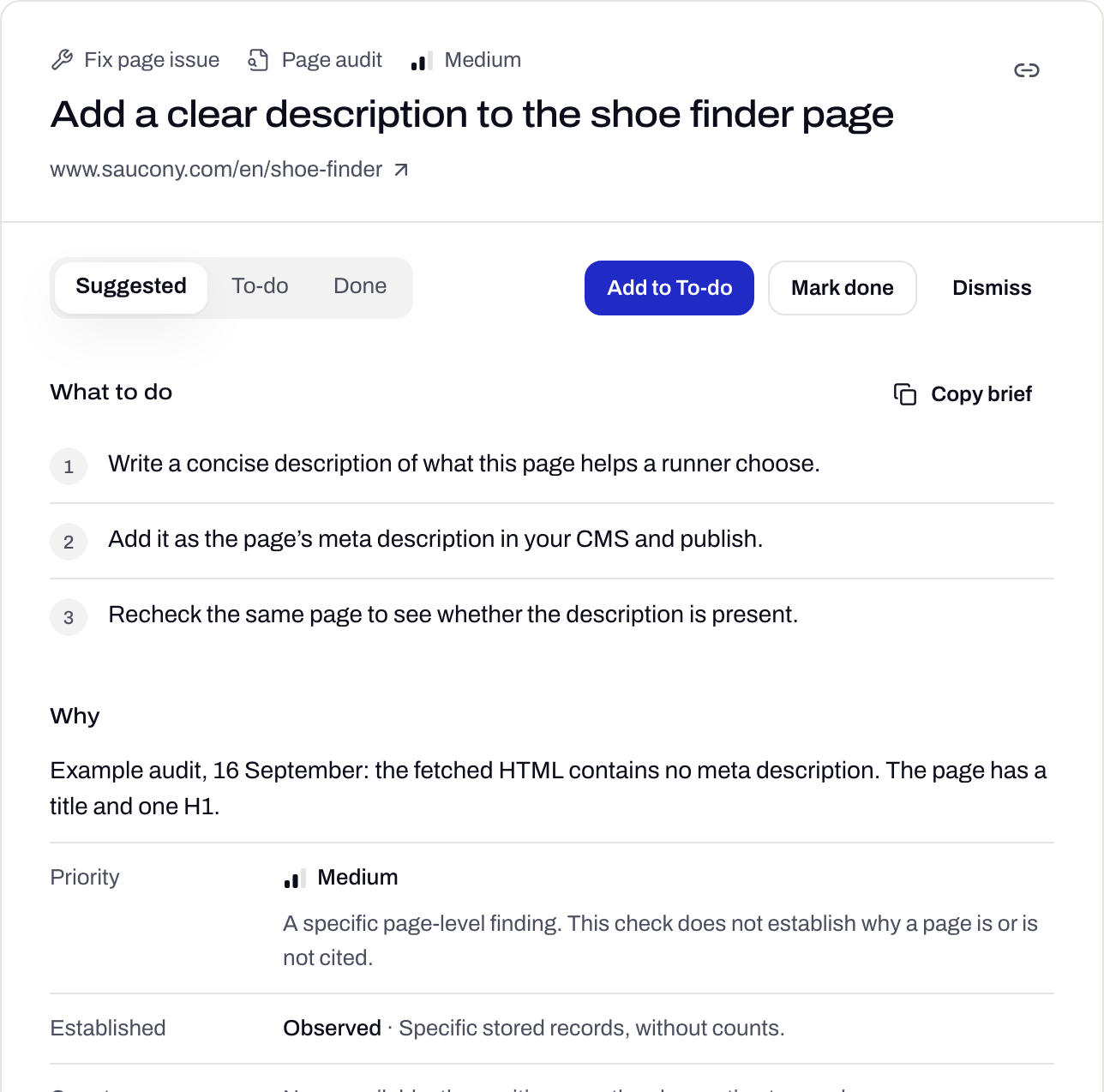
Add to To-do carries the evidence along
Turn a cited page into a To-do and it arrives with the page, the verdict, the questions and the steps, ready to hand to a writer.
By domain
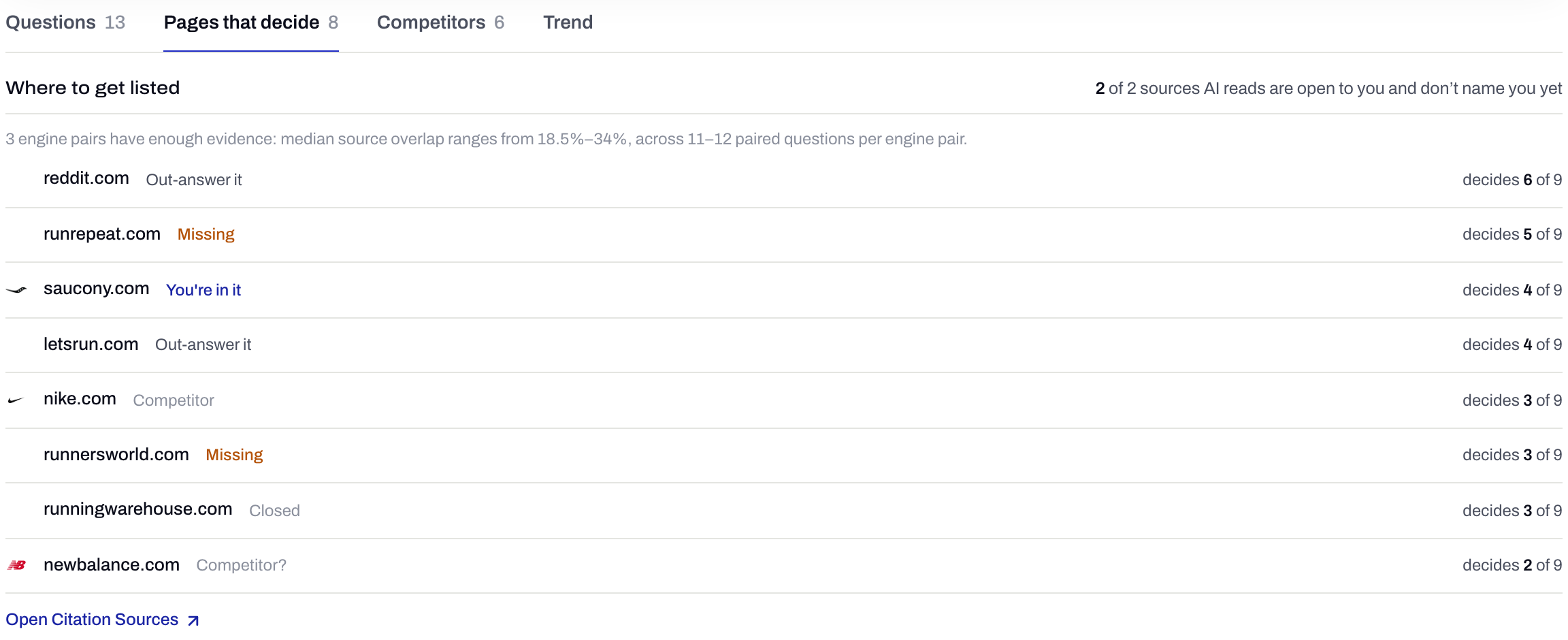
The domains that decide your category
The same citations rolled up by site: how many of your questions each domain decides, and whether it is open to you, missing you, a competitor or closed.
How it works
Included on every plan. The number of prompts you track decides how many questions feed the list.
Compare plansCollect every cited URL
Search-grounded engines return the sources they used next to the answer. We store that list per question, per engine, per run, from the structured data the API returns rather than links scraped out of the text.
Read each page
We fetch the page and look for your brand: present, absent, or unread. A page we could not read is never counted as absent, because "not checked" and "not there" call for different work.
Classify and judge
Each page gets a type from its URL and a verdict from its type, your presence and whether it is yours. Your own cited pages count as wins.
Roll up by domain
The same rows show which hosts supply the most citations in your category, so you can see that five sites write half your answers instead of scrolling forty URLs.
Where it sits
Step 2 of the loop
- CheckAsk every engine your buyers’ questions
- Find the sourceSee which pages the answer came from
- Do the workShip the To-do with its evidence
- Check againSee whether the answer moved
AI citation tracking against backlink tracking
| Aspect | Backlink tracking | AI citation tracking |
|---|---|---|
| Counts | Pages that link to you | Pages the AI answer was built from |
| Includes pages without you | No | Yes, those are the targets |
| Tied to a question | No | Every URL carries the question and engine |
| Next step | Up to you | A verdict and a To-do per page |
What it doesn’t do
- We can tell you a page was cited. We cannot tell you which sentence in it earned the citation.
- Page type comes from the URL, so a blog hosted on a review site's subdomain can land in the wrong group.
- Pages behind a login or a hard bot wall stay unread, which on some review sites is permanent.
- A citation is not a click. This measures whether the answer used you, not traffic.
- It only covers questions you track. A buying question nobody added is invisible to it.
- It says nothing about your own site. Whether the engines can read you at all is the GEO audit.
Try it free
The free version: which sites supply the AI answers in your category, and whether your domain appears at all.
Questions
What is AI citation tracking?
Recording the pages AI assistants cite when they answer a question, over time. CueScout adds whether your brand is on each page and what you could do about it.
Where do the cited URLs come from?
From the answers themselves. When an engine answers with web search on, it returns the pages it used, and we store every one against the question and the engine.
Why are so many of my cited pages Reddit threads?
Because the engines retrieve them for buying questions. In our own July 2026 check of our category, 10 of the 22 URLs Perplexity cited were Reddit threads. The useful response is still a page on your own site that answers the thread's question well.
Which domains do AI engines cite most?
It depends on the category, which is why we compute it per account. Review sites, community threads and a few publishers usually lead. Your Sources screen ranks them for your questions.
Can I see this without signing up?
Yes. The free AI Citation Source Radar runs three questions for any domain and shows the top cited pages and domains.
Related features
All featuresSee what the AI answers say about you
Your first check is free, with no signup to start.