AI visibility tracking
The AI visibility tracker that shows why you were left out
CueScout is an AI visibility tracker. Every day it puts the buying questions your customers ask to ChatGPT, Perplexity, Gemini, Google AI Overviews, and Google AI Mode, then records whether each answer named you, linked to you, or recommended someone else. You get a share of AI voice against your competitors, and every question stays one click away from the full answer.
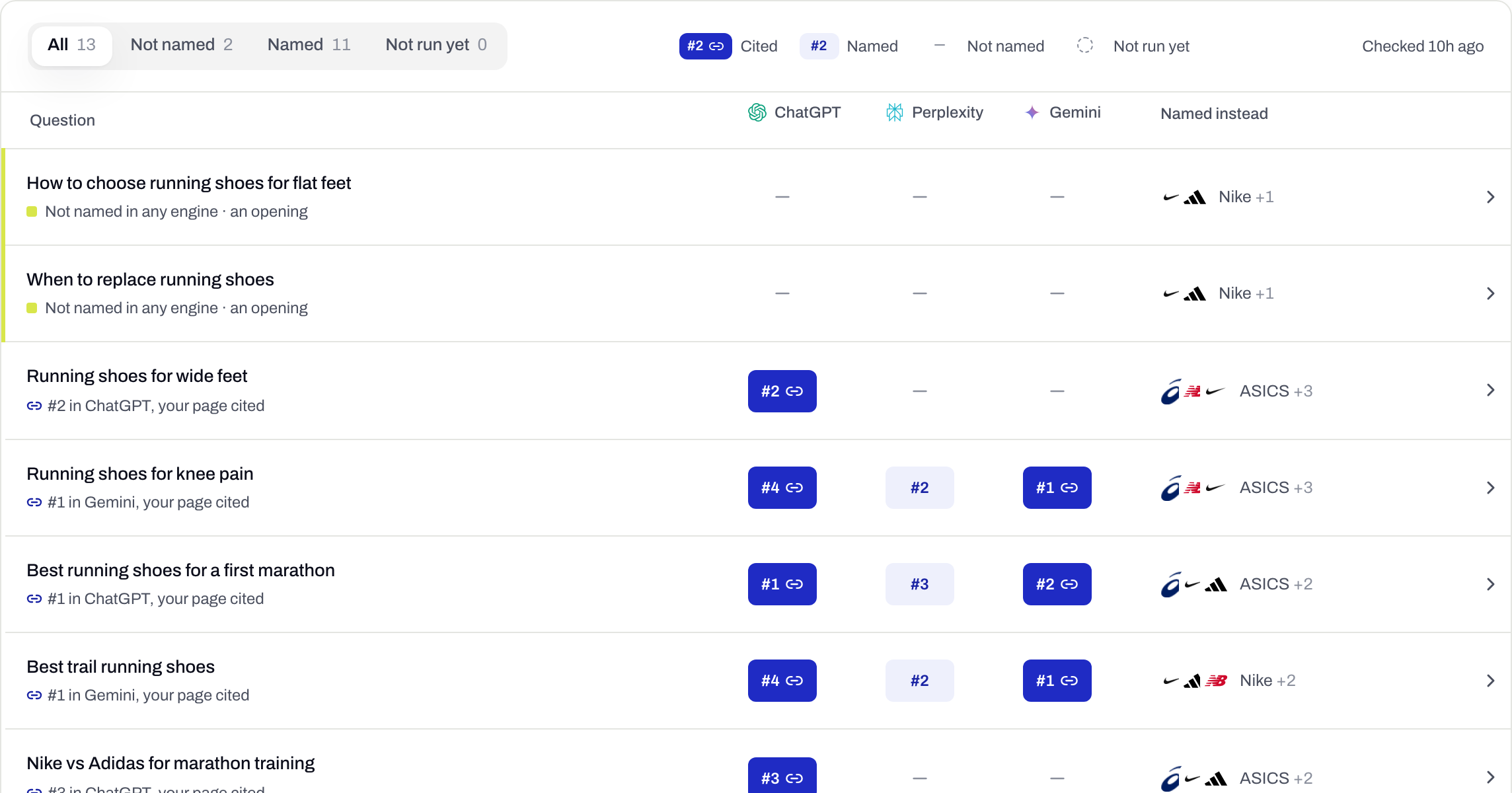
- 1Named nowhere: an opening
- 2Rank and link, per engine
- 5
- AI answer surfaces on Growth, 3 on Starter
- Daily
- every prompt, on each engine your plan covers
- 80 / 40
- points for a citation against a bare mention
- 100
- prompts on Growth, shared across brands
What the tracker records for every answer
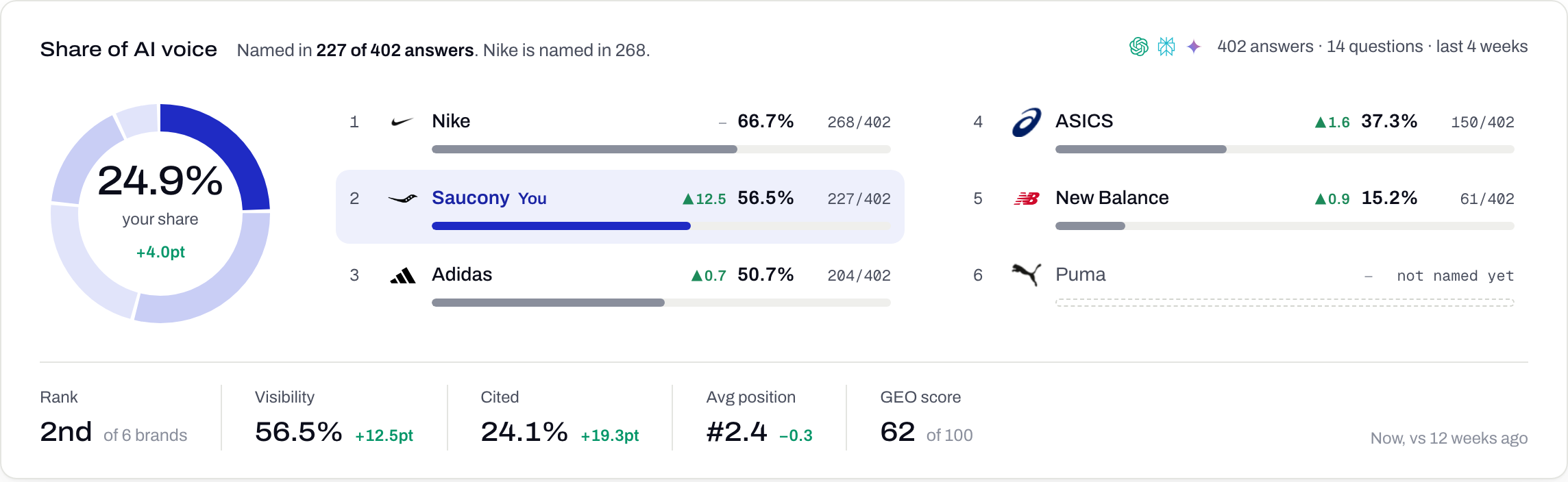
Share of AI voice
Your share, ranked against each rival
The panel at the top of Visibility: how many answers named you, your share next to every competitor, and five numbers underneath, each compared with the last window.
Scoring
A link is worth double a mention
One question on one engine is one datapoint. The score is their average, capped at 100.
- Not named0
- Named40
- Cited with a link80
- Ranked in Googleup to +20
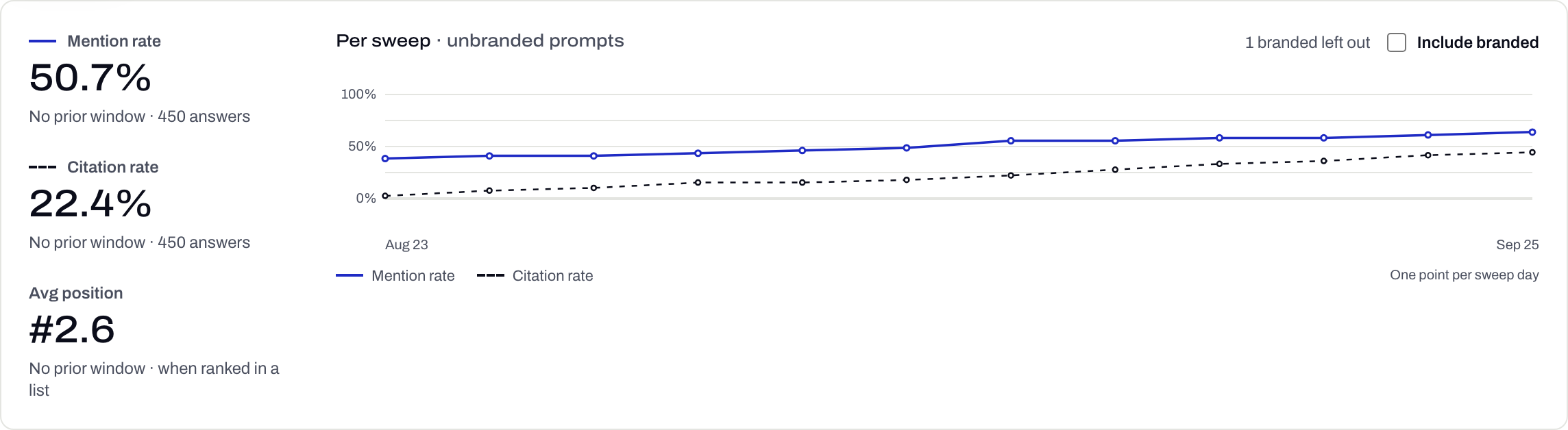
Over time
Mention and citation rates, sweep by sweep
Pick 28 days, 12 weeks, 6 months or 12 months. Each window is compared with the one before, so a move shows as a move and not as a new number.
The answer itself
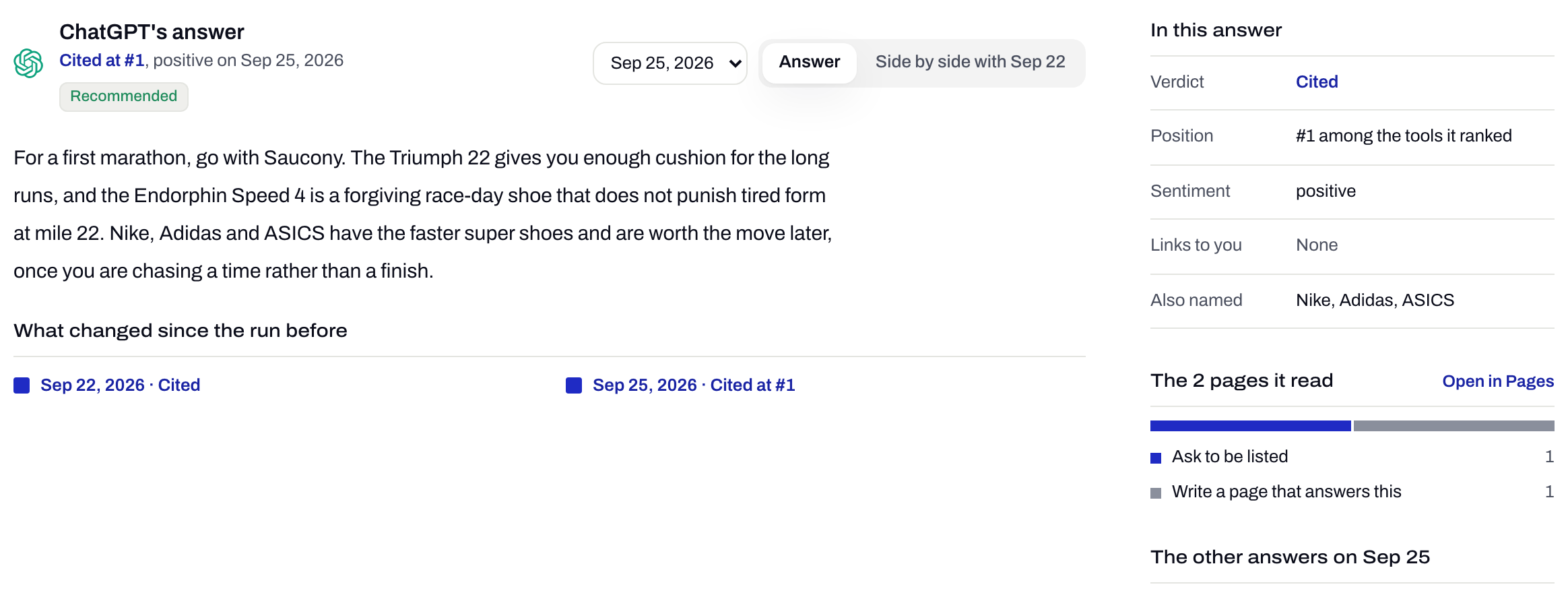
What the engine actually said about you
Every check keeps the full answer, its sentiment and the pages it read. An answer that names you unkindly is a different problem from one that leaves you out.
How it works
Starter checks ChatGPT, Perplexity, and Google AI Overviews for 20 prompts. Growth checks all five surfaces for 100. Claude is a paid add-on, and the Grok pack asks Grok 20 questions you pick each week.
Compare plansStart from your buying questions
CueScout reads your site and suggests the questions a buyer would ask an assistant. You keep the good ones, paste your own, and pause any you stop caring about.
Ask each engine on your plan, daily
Starter checks ChatGPT, Perplexity, and Google AI Overviews. Growth adds Gemini and Google AI Mode. ChatGPT, Perplexity and Gemini are asked through their search-grounded APIs. The two Google surfaces are read from Google's own results page.
Score only what could have cited you
An engine answering from memory cannot link anyone, so those answers count toward the mention rate and are left out of the citation rate. Otherwise one ungrounded engine would halve your citation rate overnight.
Watch it move
Rates, rank and share of voice are compared with the previous window. On Growth, a webhook can post changes to Slack, Discord, Zapier, Make or n8n, so nobody has to open the dashboard to notice.
Where it sits
Step 1 of the loop
- CheckAsk every engine your buyers’ questions
- Find the sourceSee which pages the answer came from
- Do the workShip the To-do with its evidence
- Check againSee whether the answer moved
An AI visibility tracker against checking ChatGPT by hand
| Aspect | By hand | CueScout |
|---|---|---|
| Questions covered | The few you remember to type | Up to 100, every day |
| Engines | Usually just ChatGPT | Five surfaces, plus Claude and Grok as add-ons |
| Competitors | Whoever you happen to notice | Each tracked rival ranked on the same answers |
| History | A screenshot in a doc | Every answer stored, with what changed |
What it doesn’t do
- Answers vary from run to run. One check is weak evidence, which is why every prompt runs daily and the numbers are meant to be read as a trend.
- We ask the engines through their APIs. That is close to what a logged-in person sees in the chat app, but not identical, especially with memory and personalisation on.
- A score going up does not prove your work caused it. It proves the answers changed.
- We do not report how many people ask a question. No public source measures assistant query volume, and a made-up number would be worse than none.
Try it free
One question, one engine, no signup: does ChatGPT name you, cite you, or recommend someone else.
Questions
What is an AI visibility tracker?
A tool that asks AI assistants the questions your buyers ask, on a schedule, and records whether the answers mention or link to your brand. CueScout also stores which competitors were named instead and which pages the answer was built from.
Which AI engines does it track?
ChatGPT, Perplexity, Gemini, Google AI Overviews, and Google AI Mode. Starter checks ChatGPT, Perplexity, and Google AI Overviews. Growth adds Gemini and Google AI Mode. Claude is a paid add-on, and the Grok pack asks Grok 20 questions you pick each week.
How is the visibility score calculated?
Each question on each engine scores 0 if you are absent, 40 if the answer named you and 80 if it cited your domain, plus round(20 ÷ Google rank) when your page ranks, capped at 100. The score is the average across all of them.
Why is my score zero on day one?
Because most brands are missing from the answers in their category when they start. That first reading is the baseline the rest of the product exists to move.
How often are the answers checked?
Every prompt, on each engine your plan covers, every day. A prompt you add is checked once straight away so its row is never blank.
Is this the same as what I see in ChatGPT?
Close, not identical. We use the engines through their APIs with web search on. Your own chat history, memory and location can change what you see logged in.
Related features
All featuresSee what the AI answers say about you
Your first check is free, with no signup to start.