Rank overlap
AI citations vs search rankings: 58 of 96 cited pages ranked nowhere
Rank overlap compares AI citations with search rankings. For every page an AI engine cited, CueScout looks up where that page ranks for the same question. Ranks come from Brave Search, an independent index, checked 100 results deep. In the account where we first ran it, 58 of 96 cited pages had no position in the top 100, so a rank tracker was watching a different contest from the one deciding the AI answer.
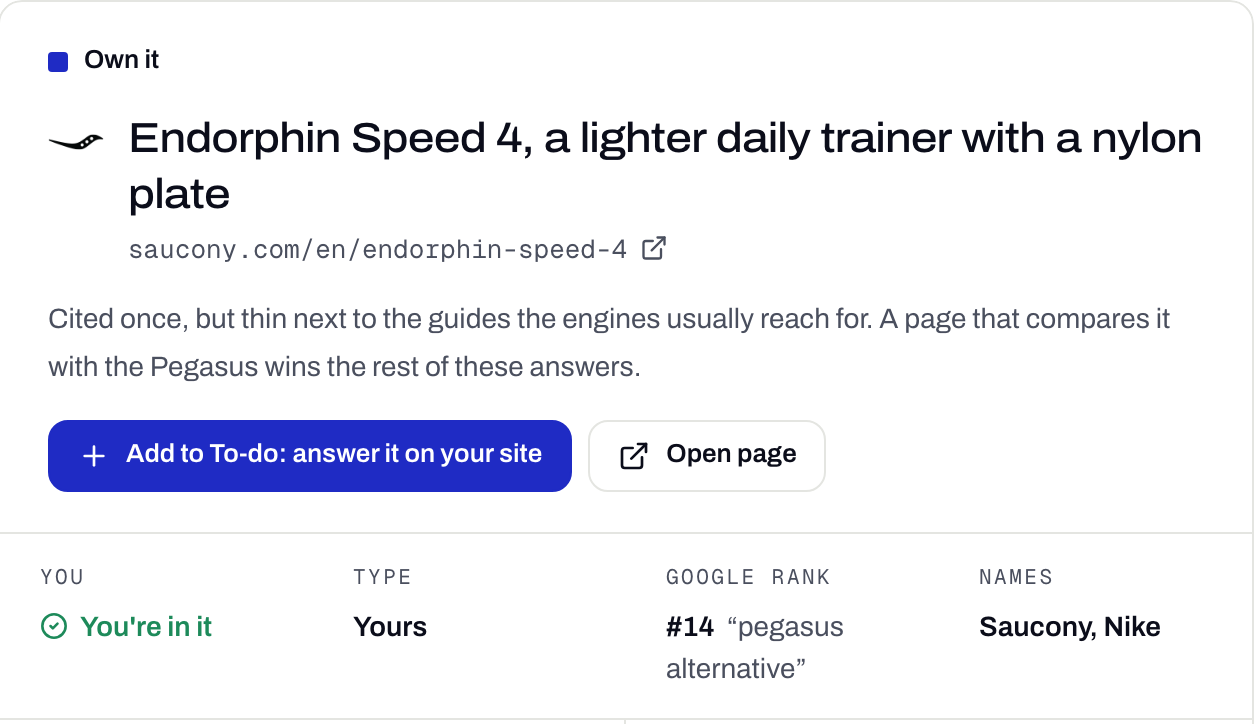
- 1Search rank for the question it was cited for
- 58 of 96
- AI-cited pages had no position in the top 100 search results for the same question (one account, August 2026, Brave Search index)
- 100
- results deep before a page counts as unranked
- 7 days
- between rank lookups for the same question
- 74%
- of AI Overview citations were somewhere in Google's top 100 (SE Ranking, Dec 2025)
What rank overlap shows for each cited page
Four outcomes
Where the cited page sits in search
The rank is looked up for the exact question the page was cited for, not for the page in general.
- Top 10
- 11 to 100
- No position in the top 100
- Discussions cluster only
In context
Rank next to every other fact about the page
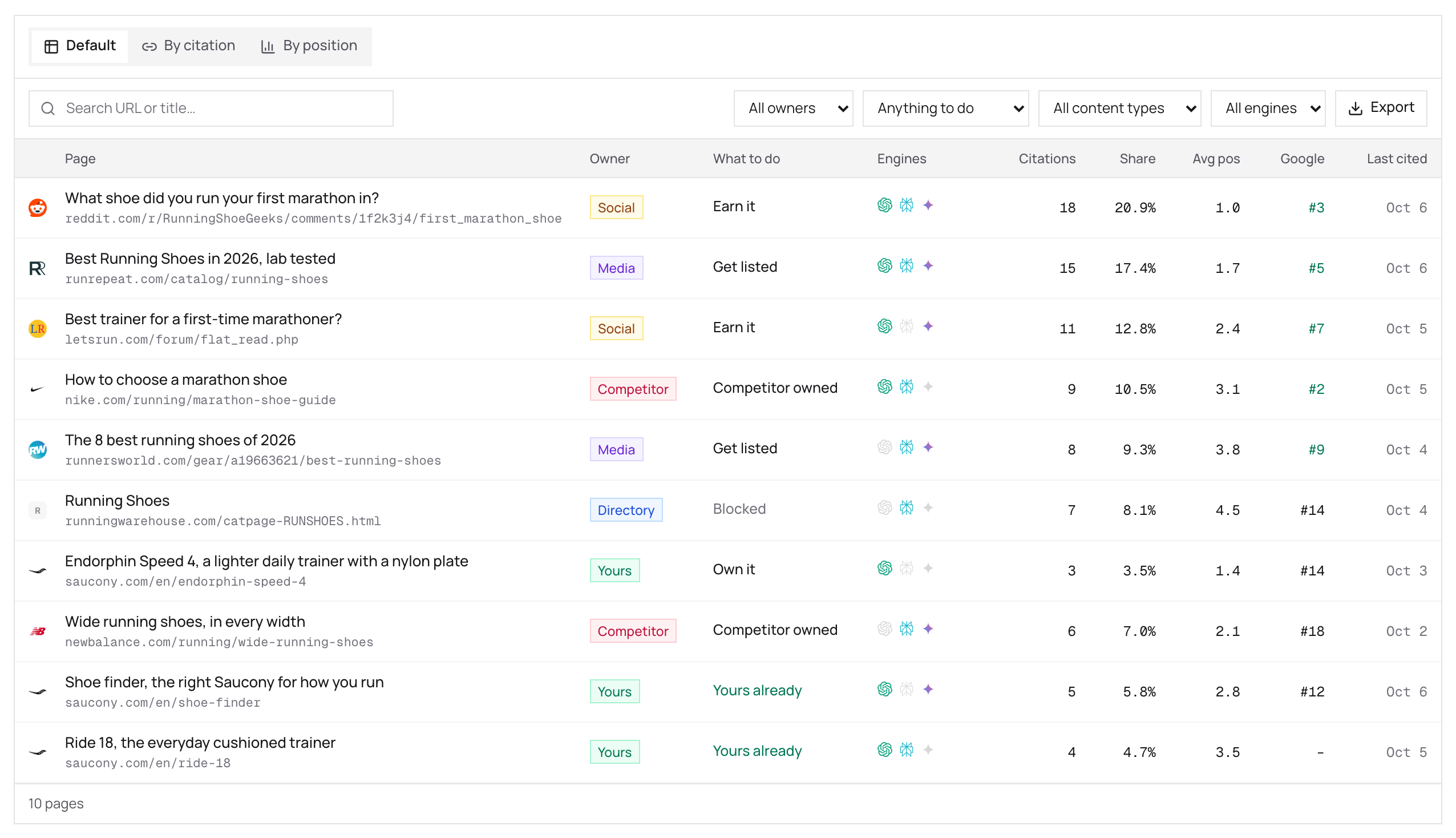
The rank sits beside the verdict, the page type, the engines that cited it and whether you're on it, so an unranked page with a Get listed verdict reads as the opportunity it is. The verdicts come from tracking every cited page.
Why it matters
Ranking is neither necessary nor sufficient
About three quarters of cited pages in the SE Ranking study ranked somewhere, which is not nothing. But a large share of what gets cited is pages you would never have found in a keyword report, and those are often the easiest to get onto.
Pair each page with its question
The same page can be cited for several questions and rank differently for each, so the lookup runs on the pair. One search covers every page cited for that question.
Search a hundred results deep
Past a hundred, "does not rank" and "ranks at 140" are the same fact to a buyer. A page with no position is a finding, not a gap in the data.
Treat forum results honestly
Reddit and Stack Exchange threads often appear only in a separate discussions block, not in the ranked list. Those are flagged as such rather than reported as unranked.
Refresh weekly
Organic results move slowly, so a position is reused for seven days. A failed lookup waits a day before it is tried again.
Where it sits
Step 2 of the loop
- CheckAsk the engines your buyers’ questions
- Find the sourceSee which pages the answer came from
- Do the workShip the To-do with its evidence
- Check againSee whether the answer moved
What it doesn’t do
- 58 of 96 is one account's number. It is the strongest figure we can publish and we will not dress it up as a benchmark.
- Rank comes from one search provider, Brave Search, in one locale, at one moment. Google positions will differ, and so will personalised and local results.
- A page ranking nowhere and being cited anyway does not tell you why it was cited. It tells you ranking was not the reason.
Questions
Do AI engines cite the pages that rank first in Google?
Sometimes. SE Ranking found 36% of AI Overview citations in the top 10, 54% in the top 20 and 74% in the top 100, across 465,823 citations of German-language health queries in December 2025. Treat that as proof the gap exists, not as your number.
Is GEO different from SEO?
They overlap. GEO is getting your brand into AI answers, and ranking helps with that, but the answers also lean on forums, roundups and review sites that a keyword report never shows you. Rank overlap measures how big that second group is for your questions.
Which search engine do you check against?
Brave Search, an independent index, including its discussions block. Its API returns forum results separately, which is what lets us report them honestly. Positions in Google can differ.
Does this mean SEO does not matter?
No. It means ranking is one input, and that some of the pages doing the most work in AI answers are ones an SEO audit would never look at.
Related features
All featuresSee what the AI answers say about you
Your first check is free, with no signup to start.