Search Console tells you what people type into Google and where your pages rank for it. An AI citation tracker tells you whether ChatGPT, Perplexity or Google's AI Overviews name you when someone asks the same thing. Read in separate tabs, each one points you at a different page, and often the wrong one.
This post is the workflow we built to read them together, shown on one real query from our own site. The numbers are small. It is a small site, and a "before" is supposed to look bad.
Why one signal on its own misleads
Search Console on its own pushes you toward volume. The query with the most impressions looks like the biggest opportunity, even when you rank 74th for it and nothing short of a new page and a pile of links will move it. It also cannot tell you anything about AI answers. Google counts AI Overviews and AI Mode inside the normal Web numbers, and an AI Overview takes a single position, with every link in it sharing that position. You can see that you showed up. You cannot see whether the answer recommended you or a competitor.
AI citation tracking alone has the opposite problem. It tells you that you are missing from an answer, but it cannot say whether anyone searches for that question, or whether you already have a page that nearly ranks for it. Every missing answer looks equally urgent.
Joined up, you get a better question: where do people already search for this, do I already have a page about it, and do the engines still leave me out? A yes to all three is a near miss on both sides, and it is the cheapest fix you have.
Connect Search Console: what gets read
CueScout connects through Google's OAuth with the read-only Search Console scope. From the property you pick, it asks the Search Analytics API for the query and page dimensions together, for Web search, over 90 days ending two days ago, because the last couple of days are still incomplete. Asking for both dimensions at once matters. The Performance report in the Search Console UI shows queries and pages as separate tabs, so you can see that a query got impressions and that a page got impressions, but not which page took which query.
Before anything is ranked, three kinds of query are filtered out:
- searches for your own brand, which are traffic but not a topic gap
- search-operator queries (
-site:and friends) from scrapers checking who ranks - prompt-shaped queries of twelve words or more, which AI visibility tools fire at Google and no person types
Google also leaves out anonymized queries, the ones too few people searched over two to three months. So the table is always a sample of your demand, and the long tail is the part you will never see.
Read the two views side by side
The Google Search tab lists what people searched, the page Google sent them to, and the position. Here is the row this post is about:

"best alternative to peekaboo" got 64 impressions and 0 clicks between 6 July and 4 October 2026, at an average position of 18.3. That puts it on page two. The landing page was /compare/peekaboo-alternative, so the page was about the query, and Google mostly agreed it was relevant. It just was not good enough for page one.
Then the AI side. We track a prompt that asks the same thing in the words a buyer would use in ChatGPT: What are good alternatives to Peekaboo for tracking AI assistant citations and brand mentions across multiple LLMs?
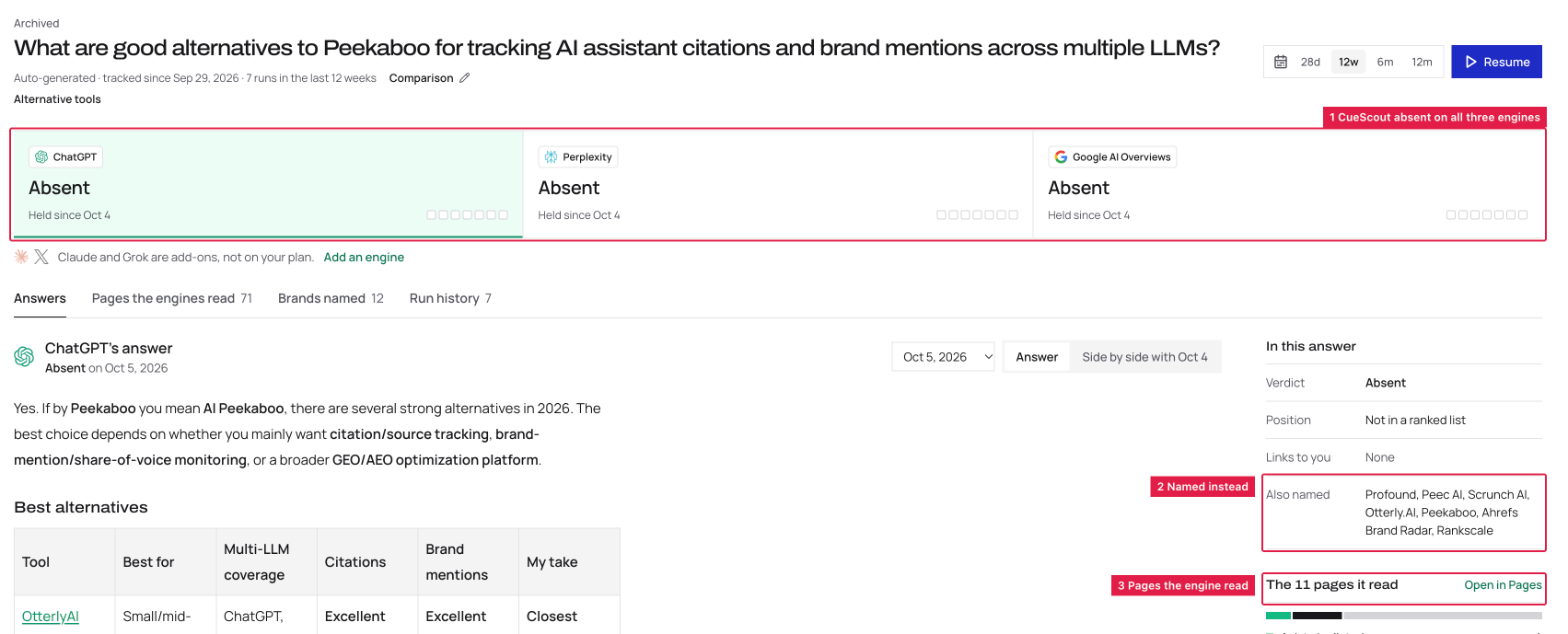
Over 7 runs that came to 25 answers across ChatGPT, Perplexity and Google AI Overviews, and CueScout was named in none of them. Otterly.AI was named in 21, Profound and Peec AI in 17 each, AthenaHQ in 14. The pages the engines leaned on most were on semrush.com and zapier.com.
Put the two together and the priority is clear. People search this, we have a page about it, and both Google and the answer engines pass over it.
How near misses become To-dos
SEOs usually call these striking distance keywords: queries where a page already ranks just off page one. The difference here is that we only count the ones where the page is already about the query, and we check the AI answers for the same question before ranking them. Not every near miss becomes a task. CueScout applies four rules, and each one exists because we got it wrong without it:
- On-topic. The page's own URL has to cover at least 60% of the meaningful words in the query. Otherwise the query is landing on a page about something else, and the job is a new page rather than an edit.
- Position 5 to 30. Above 5 there is little to gain. Past about 30 the page is losing on authority, and a better heading will not change that.
- At least 20 impressions in the 90 days. Fewer than that is noise, and building a task on it teaches you that the list guesses.
- A cap. At most five Search Console suggestions wait in the queue at once, near misses and new-page gaps together, the most-searched first. Anything you already accepted stops counting against the five. Without the cap the list turns into a keyword report.
When a query passes, the To-do carries its evidence and three steps:
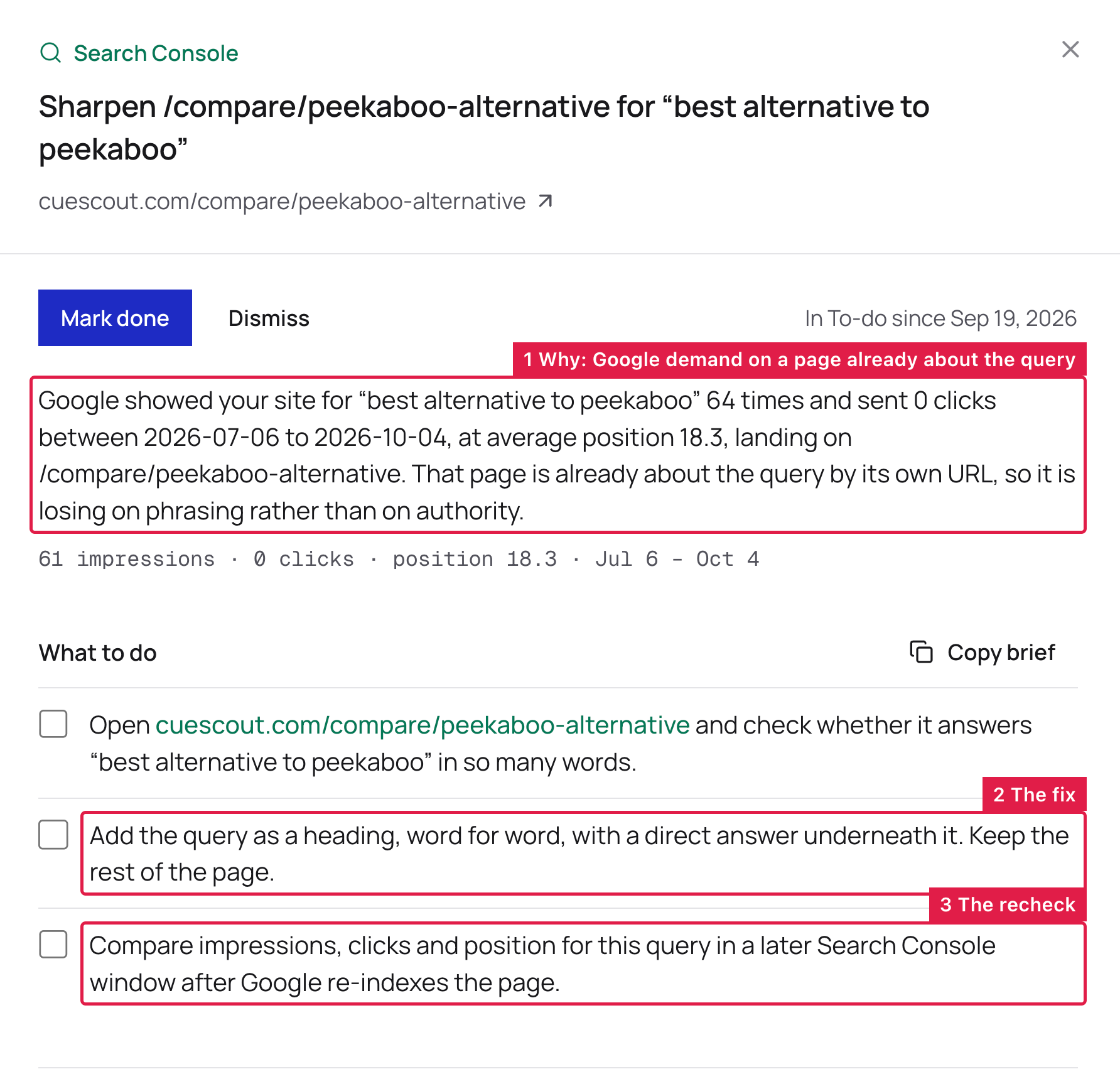
The reason explains why this is a phrasing problem: the page is already about the query by its own URL, so Google trusts it enough to show it on page two. The steps are almost boring on purpose. Check whether the page answers the query in so many words, add the query as a heading with a direct answer under it, and compare the numbers in a later window.
The fix, and the trap we hit
When I opened /compare/peekaboo-alternative to make the edit, it redirected. We had folded it into /compare/peekaboo-vs-otterly-vs-cuescout on 22 September. Search Console still reported the old URL because its 90-day window reaches back to before the redirect, and the To-do inherited it.
So the fix went on the page the redirect lands on. On 7 October I added "What is the best alternative to Peekaboo?" to that page word for word, with a three-sentence answer: Otterly for daily data, CueScout for cited pages and a To-do list, and Peekaboo itself if you need 40 or more prompts and can wait two days between checks. Nothing else on the page changed, so if the numbers move, we know which edit did it.
The recheck loop
The recheck has two halves, and each one reads the same thing it read before:
- Search Console: the same query, in a fresh 90-day window, once Google has recrawled the page. The things to watch are position and clicks for "best alternative to peekaboo", not the site total.
- AI answers: the same tracked prompt on the same three engines. One answer tells you very little, because answers vary from run to run, so compare the share of runs that name you before and after.
Both halves have to be read with some humility. If the page starts getting cited, that is an observation, not proof. A competitor's page could have changed in the same weeks, or an engine could have changed how it picks sources. We record what changed and when, and we do not claim the edit caused it.
I will add the "after" numbers to this post once the recheck window has data. If nothing moves, that goes in too.
For the other half of this workflow, which is reading a single AI answer and the pages it cites, see AI visibility tracking. For how these To-dos fit into a content plan, see GEO strategy from AI answer gaps.
Troubleshooting
The To-do points at a page that redirects. Search Console reports the URL Google had indexed during the window. Fix the page the redirect lands on, and expect the old URL to drop out of the data over the next window.
A query you care about never becomes a To-do. It is probably under 20 impressions, outside positions 5 to 30, or landing on a page whose URL does not match it. Anonymized queries never appear at all.
Search Console is connected but the chart is empty. The daily totals arrive after the first pull. Refresh the connection in Settings once Google has data for the property.
The AI prompt and the Google query use different words. That is expected. People type three words into Google and ask ChatGPT in a full sentence. Match them by meaning, and track the prompt the way a buyer would ask it.
Frequently asked questions
Does Search Console show AI Overviews and AI Mode traffic?
Yes, mixed in. Google's documentation says appearances in AI features such as AI Overviews and AI Mode are included in the Performance report under the Web search type. They are not split out, so Search Console cannot tell you whether an engine named or cited you. That is the gap AI citation tracking fills.
What is a near-miss query?
A query where Google already sends you to a page that is about it, but the page ranks too low to get clicks. We use positions 5 to 30. Above 5 the page is already winning. Past 30 the problem is usually authority, and rewording one heading will not fix that.
Why does Search Console show a different number of impressions on the To-do and in the table?
Because a query can land on more than one page. In our example the table showed 64 impressions for the query. The To-do split those into 61 on the page Google mostly chose and 3 on a second page. The To-do is written about the page taking most of the query.
How long before the recheck means anything?
Give Google a few weeks to recrawl the page and for a new window of data to build up. AI answers can change sooner, but a single day's answer moves around, so compare several runs rather than one.
Can CueScout change my site or my Search Console?
No. The connection asks Google for read-only access to Search Console, and CueScout does not publish anything. You make the edit in your own CMS.